


|
Getting your Trinity Audio player ready...
|
Artificial intelligence is already changing the way a lot of industries work, and according to a new DEWALT study, construction could be next in a big way.

The problem? While tradespeople clearly see AI becoming part of the jobsite, most aren’t actually using it yet.
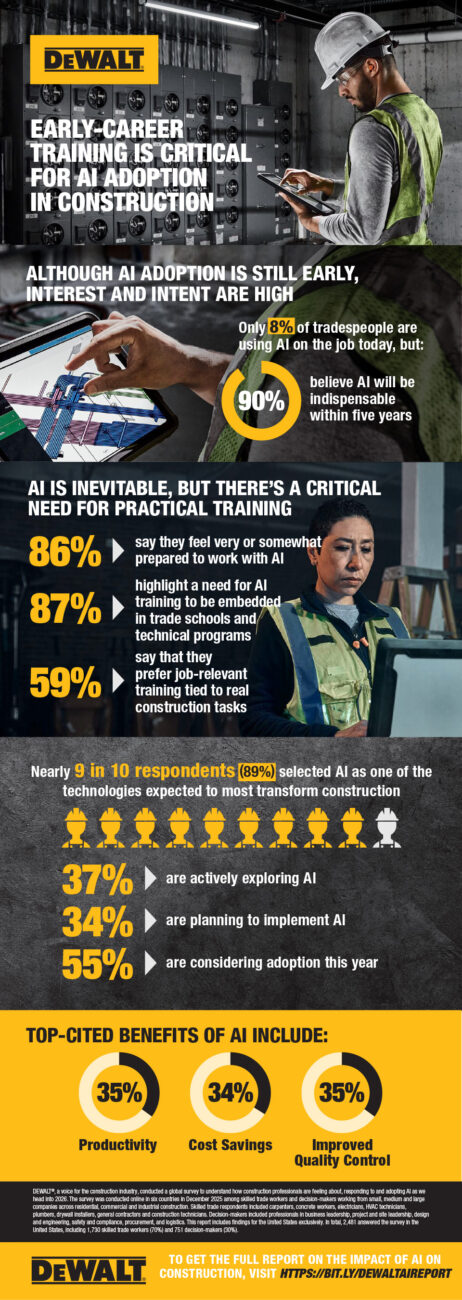
DEWALT’s new AI in the Trades Survey found that 90% of U.S. construction professionals believe AI will be indispensable within the next five years, but only 8% currently use AI as part of their everyday work.
That is a pretty massive gap, and DEWALT’s research suggests the issue isn’t necessarily a lack of interest. It’s a lack of practical training.

For an industry that has always been built around hands on experience, apprenticeships, and learning skills that directly apply to the job, that distinction matters.
If AI is going to become another tool construction professionals are expected to understand, workers need to see how it actually helps them build, plan, estimate, monitor, and manage projects, not just hear about AI in theory.
Construction Pros Expect AI Adoption to Move Fast
AI adoption may still be relatively early in construction, but expectations for the technology are already high.
According to DEWALT, 88% of construction professionals expect AI adoption to increase over the next year, while 83% believe AI will become standard within three years. Looking a little further ahead, 90% believe it will be indispensable within five years.
The accompanying survey data goes even further, with 99% of respondents identifying AI as one of the technologies expected to have the biggest impact on the future of construction.
At the same time, the industry is still figuring out exactly where AI fits.
Only 8% currently use AI in their day-to-day work, while 37% are actively exploring or piloting the technology. Another 34% are planning to implement AI, and 55% are considering adopting it this year.
So while AI might not be part of every electrician’s, plumber’s, carpenter’s, HVAC technician’s, or contractor’s daily routine yet, there is clearly a lot of interest in figuring out what it can do.
Where Is AI Already Being Used in Construction?
When people hear “AI in construction,” it’s easy to jump straight to robots replacing workers or completely automated jobsites.
That isn’t really what DEWALT’s research is showing.
For early adopters, AI is showing up more in the workflows surrounding the physical work.
According to the survey, 46% are exploring AI for site operations and monitoring, while another 46% are applying it during the planning and design phase of projects. About 41% are looking at AI for estimation, procurement, and supply chain processes.
Those applications make a lot more sense when you look at how much information goes into a modern construction project.
AI could help teams work through project documentation faster, assist with estimating, organize jobsite information, identify scheduling issues, improve material planning, analyze site data, or streamline some of the repetitive administrative work that takes time away from the actual job.

Among the construction professionals already testing AI, the benefits are starting to become clearer. 35% cited improved productivity, 34% reported cost savings, and 35% identified improved quality control as major benefits.
That doesn’t mean AI is suddenly doing the work for skilled tradespeople. It means it may become another way for them to work more efficiently.
Training Is Where Construction Is Falling Behind
This is probably the most important part of DEWALT’s entire study.
While AI adoption is still limited, 86% of construction professionals said they feel somewhat or very prepared to work with AI.
But when you look at how they’re actually learning it, there isn’t much structure.

Many tradespeople are figuring it out themselves. Around 40% are turning to YouTube for AI education, while 39% are using online learning platforms such as Coursera. Video tutorials are also one of the most preferred forms of education, with 42% of respondents favoring that style of training.
There’s nothing unusual about that in the trades. People have always learned by watching someone else do something, testing it themselves, and figuring out what works.
But AI is becoming complicated enough that YouTube videos alone probably aren’t going to prepare an entire workforce.
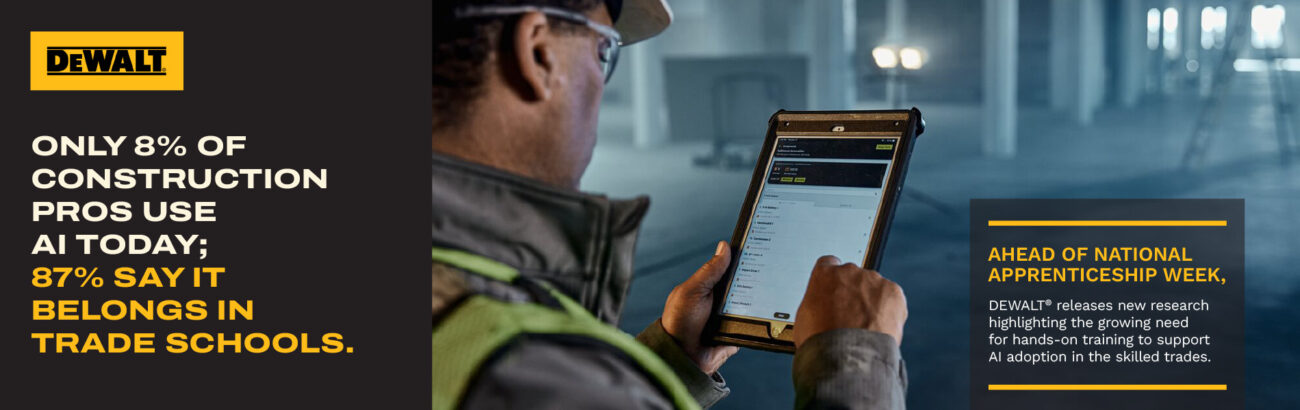
That’s why 87% of respondents said AI education should be built into trade schools and technical programs, while 59% said they want job-relevant AI training tied directly to real construction tasks.
And that last part might be the key.
Construction professionals don’t necessarily need a class explaining how artificial intelligence works behind the scenes. They need somebody to show them how it applies to their job.
Show an estimator how AI could help organize project information. Show a superintendent how it could help with documentation and site monitoring. Show an apprentice where AI can save time without replacing the skills and knowledge they still need to develop.
That’s when AI stops being a buzzword and starts becoming another practical tool.
DEWALT Is Partnering With ABC to Bring AI Training to the Trades
DEWALT isn’t just pointing out the training gap. The company is also working with Associated Builders and Contractors (ABC) to start addressing it.
DEWALT is launching an AI training pilot through the ABC Central Florida chapter’s Innovation and Technology Center, with a focus on practical, jobsite-relevant AI education for apprentices and young construction professionals.
As part of the program, DEWALT facilitated a case-study session for participants in ABC Central Florida’s NextGen leadership program. The session brought in a senior virtual design and construction manager from a national construction company to demonstrate real-world AI applications and provide steps workers could begin using immediately.
That real-world approach is important because it gives workers more than a general introduction to AI. It shows them where the technology is already being used and how it could realistically fit into their work.
DEWALT Commits $75,000 to AI Education
DEWALT is also expanding the effort beyond one pilot program.
The company has committed $75,000 to ABC’s Trimmer Construction Education Fund for grants supporting AI-related education initiatives.
ABC chapters across the United States will be able to apply for funding to establish AI training programs and resources in their own regions.

The Trimmer Construction Education Fund already supports training initiatives designed to build a safer, more skilled, and more sustainable construction workforce, so adding AI education gives local programs another opportunity to prepare workers for how construction could change over the next several years.
DEWALT is also supporting ABC’s AI Toolbox Talks webinar series, which provides monthly training to ABC’s approximately 24,000 member companies. The series is designed to help construction companies understand AI adoption and its potential impact on areas including project design, robotics, and quality control.
This Is Bigger Than AI
DEWALT’s AI initiative is also part of a much larger effort focused on the future of the skilled trades.
Through its Grow the Trades program, DEWALT has committed to investing $60 million by 2030 to expand access to training, education, and resources for the trades.

And AI training could become an increasingly important piece of that investment.
The skilled labor shortage isn’t going away overnight, which means the industry is constantly looking for ways to help the existing workforce become more productive while also preparing the next generation of workers.
AI may eventually play a role in both.
That doesn’t mean replacing tradespeople. It could mean giving them better ways to manage the parts of their jobs that don’t necessarily require someone to physically turn a wrench, pull wire, install pipe, frame a wall, or pour concrete.
AI Probably Isn’t Taking the Tool Belt
There is obviously going to be some skepticism anytime AI and skilled labor are mentioned in the same sentence.
And that’s understandable.

A computer can’t walk onto a complicated jobsite and suddenly have the years of experience that tell a skilled worker when something doesn’t look right. It doesn’t have the physical ability, field judgment, or problem-solving experience that comes from actually doing the work.
But that’s also why the AI conversation in construction is worth separating from the broader “AI is replacing jobs” discussion.
For the trades, the more immediate opportunity is probably using AI to support the work rather than replace the worker.
Think faster estimates. Better project planning. Easier access to information. Smarter jobsite monitoring. More efficient procurement. Improved quality control. Less time spent sorting through paperwork and more time focused on actually getting the project done.
That’s a much more realistic picture of what AI on the jobsite could look like.
What Will AI in the Trades Look Like Five Years From Now?
DEWALT’s survey included 2,481 U.S. respondents, including 1,730 skilled trade workers and 751 construction industry decision makers working across residential, commercial, and industrial construction.
Those workers included electricians, plumbers, HVAC technicians, carpenters, concrete workers, drywall installers, contractors, construction technicians, and professionals involved in project leadership, engineering, safety, procurement, and logistics.

That makes the results especially interesting because this isn’t just a survey of people working in technology.
It’s coming directly from the people building things.
And right now, their message seems pretty clear: AI is probably coming to the jobsite, but the industry needs to get better at teaching workers how to use it.
If DEWALT’s respondents are right and AI becomes indispensable within five years, construction in 2031 could look noticeably different from construction today.
Maybe AI becomes another everyday tool for estimators and project managers. Maybe superintendents use it to keep jobs organized. Maybe technicians use it to quickly access information in the field. Maybe it becomes heavily connected with robotics, jobsite monitoring, design software, or quality-control systems.
Or maybe the reality ends up being much simpler than all of that.
Either way, the technology seems to be moving faster than the training around it and DEWALT is betting that preparing tradespeople now will matter later.
So, we want to hear from you. Do you think AI is actually going to become a useful tool on the jobsite? Where could you see yourself using it, and what do you think AI in construction will realistically look like five years from now? Don’t hesitate to reach out at cs@ohiopowertool.com or 614-481-2111 with any questions, comments, or concerns, and be sure to follow us on all your favorite social media channels to stay in the know on all the latest announcements, deals, news, and more!

